How to Connect Camera Vitals to Care Management Platforms
A health IT analysis of how teams connect camera vitals to care management platforms, covering workflow design, interoperability, and evidence on contactless monitoring.
How to Connect Camera Vitals to Care Management Platforms
Health systems are now asking a more practical question about contactless monitoring: not whether camera-based measurement is interesting, but how to connect camera vitals to care management platforms without creating one more isolated dashboard. That question matters because care management teams already work inside established workflows for triage, outreach, documentation, and escalation. If camera-derived heart rate, respiratory rate, or trend data cannot land in those workflows cleanly, the technology stays stuck in pilot mode.
“The challenge is no longer just signal extraction. It is how camera-based vital signs are embedded into care pathways that clinicians already use.” — Mayank Kumar, Anirban Das, and S. R. M. Prasanna, Camera-based vital signs monitoring: a review
Connect Camera Vitals to Care Management: The Real Architecture Question
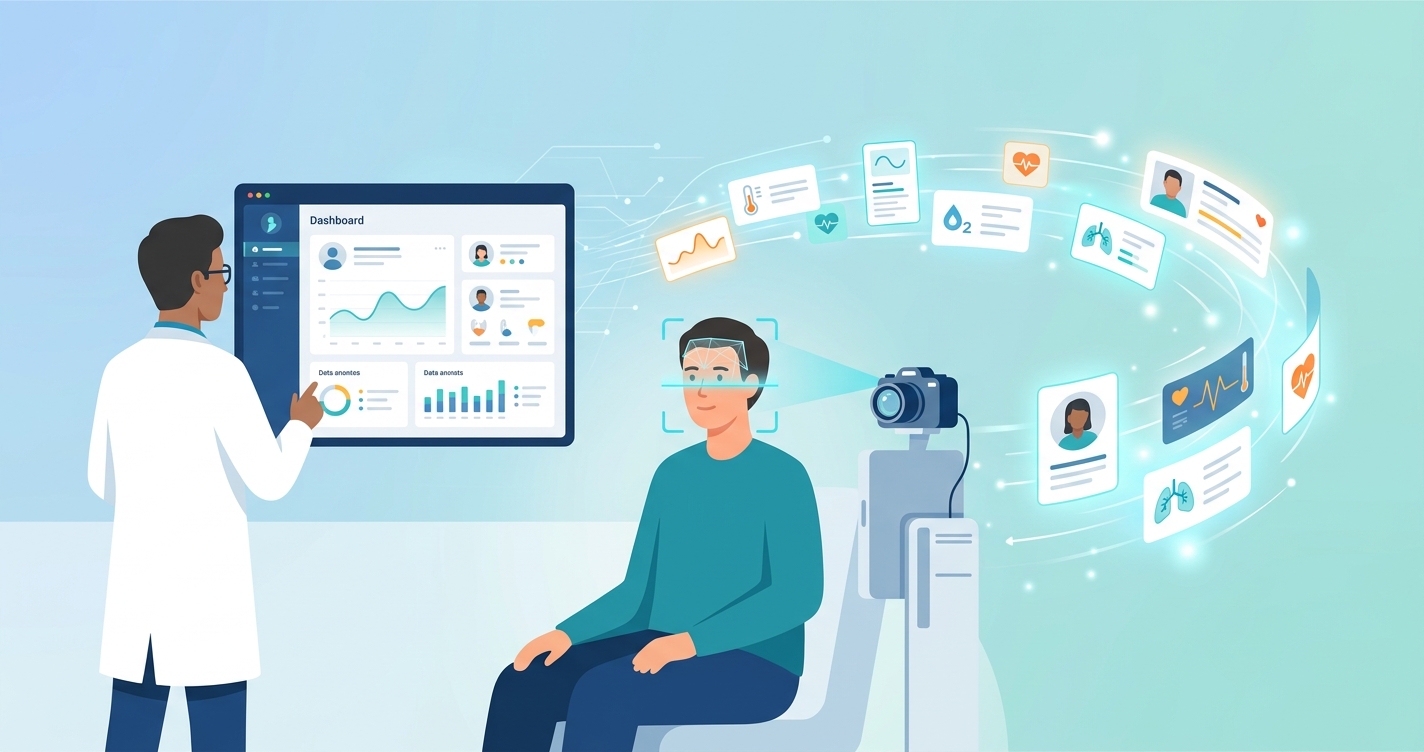
To connect camera vitals to care management systems, health IT teams usually need four layers working together: capture, normalization, interoperability, and workflow delivery. The camera experience may happen in a telehealth session, a patient mobile app, or a kiosk, but the care management platform still expects structured clinical data with timestamps, patient identity, and routing logic.
Kumar, Das, and Prasanna’s review of camera-based vital-sign monitoring described how quickly the technical literature has expanded beyond lab settings into clinically relevant use cases. That shift changes the implementation problem. The hard part is not only measuring a pulse from video. The hard part is deciding what should be stored as a discrete observation, what should trigger outreach, and what belongs in a trend view rather than an interruptive alert.
A workable integration pattern usually looks like this:
- A camera workflow captures a brief video sample during a virtual visit, intake flow, or asynchronous patient check-in
- A processing layer converts that video into structured physiological outputs and confidence metadata
- An interoperability layer maps those outputs into standards-based observations or platform-specific records
- A care management platform applies rules for triage, escalation, and follow-up tasks
That sounds straightforward on paper. In practice, the design choices change everything.
| Integration layer | What it does | Design question for care management teams |
|---|---|---|
| Capture layer | Collects video during a visit, check-in, or remote session | Is capture staff-assisted, patient self-service, or embedded in telehealth? |
| Measurement layer | Derives heart rate, respiratory rate, and other supported metrics | Which values are stable enough for workflow use, and when is a repeat capture required? |
| Interoperability layer | Maps results into FHIR, HL7, or platform APIs | Does the data flow into the EHR, care platform, or both? |
| Workflow layer | Routes results to nurses, care coordinators, or rules engines | Which readings create tasks, which create trends, and which are ignored? |
Why Care Management Platforms Need Different Logic Than Device-Centric RPM
Traditional RPM programs are usually built around scheduled device readings gathered over days or weeks. Camera vitals can appear in shorter, more situational encounters: a telehealth intake, a post-discharge outreach call, a benefits screening flow, or a chronic-care check-in. That means care management teams should not simply copy the same workflow used for cuff or scale data.
Ana Londral, writing on RPM systems aligned to integrated care, argued that monitoring tools work best when they support coordination across the care pathway rather than operating as stand-alone technology. That point is easy to miss. A contactless capture step only becomes useful when it helps a coordinator decide who needs follow-up now, who can stay in routine monitoring, and what evidence should be documented in the record.
In other words, camera vitals often behave less like a pure device feed and more like a workflow input.
Where camera vitals fit best
The strongest near-term fit is usually in moments where care teams already need a quick physiologic read:
- Virtual urgent care intake
- Care management outreach after discharge
- Chronic disease check-ins where adherence to hardware devices is low
- Hospital-at-home or transitional care screening workflows
- Benefits, wellness, or eligibility journeys that need a low-friction vital-sign touchpoint
These are not identical workflows, and pretending they are leads to messy deployments. A telehealth operations team may want immediate visit context. A care management director may care more about risk segmentation and queue prioritization.
Industry Applications for Contactless Workflow Integration
Telehealth intake and virtual triage
Camera vitals can be captured before a clinician joins the visit, giving triage teams a faster starting point. In that model, the platform should send a summarized result into the encounter context, not dump raw data into a separate monitoring console.
Post-discharge care management
For transitional care programs, the more interesting use case is not continuous monitoring. It is rapid reassessment during outreach. A coordinator can collect a fresh signal during a follow-up interaction and document whether the patient appears stable enough for routine follow-up or needs escalation.
Population health and care-gap programs
Large care management operations often need a low-friction way to gather current information from dispersed patient populations. Camera capture can lower setup burden compared with shipping hardware, especially when the objective is a quick status check rather than long-duration monitoring.
Current Research and Evidence
The evidence base is still developing, but several papers help frame what health IT teams should pay attention to.
Kumar, Das, and Prasanna’s review in Biomedical Signal Processing and Control examined the technical literature on camera-based vital-sign monitoring and described the field’s movement toward more realistic deployment conditions. It is a helpful reminder that implementation teams should expect variation in lighting, positioning, skin tone, motion, and clinical context rather than assuming controlled-study conditions.
Alora Brown, Joeri Tulkens, Maxime Mattelin, Tanguy Sanglet, and Brecht Dhuyvetters, writing in Frontiers in Digital Health, reviewed remote photoplethysmography for health assessment and outlined how rPPG systems increasingly depend on software pipelines, camera quality, and workflow design as much as signal science. For care management leaders, that matters because operational reliability is usually decided upstream in capture design and exception handling.
Ana Londral’s perspective on RPM systems that support integrated care pushed the conversation away from gadget deployment and toward system design. Her argument was simple but important: monitoring tools should support coordination, continuity, and intervention timing. That logic fits camera vitals well. The value is highest when the measurement helps the team do something concrete next.
Goutham V. Meda and Ailie H. Brennan-Davies, in their narrative review on RPM implementation challenges, also emphasized that new monitoring programs often fail when they are added to clinical work without redesigning roles, escalation paths, and documentation patterns. That warning applies here. If camera vitals create extra clicks for nurses or unclear accountability for follow-up, adoption will stall.
A prospective comparative study registered on ClinicalTrials.gov has also evaluated whether remote photoplethysmography can support contactless acquisition of heart rate, respiratory rate, and oxygen saturation in healthcare settings. Even before every implementation question is settled, the study direction tells you where the market is heading: toward operational use in real care environments, not just engineering demos.
The Future of Camera Vitals in Care Management
The next phase will probably be less about standalone “camera vital sign products” and more about embedded measurement inside existing care journeys. That means three things for health IT teams.
First, interoperability will matter more than novel measurement claims. Teams will ask whether a platform can route structured outputs into the same EHR, care management, and telehealth systems already in use.
Second, workflow governance will become a buying criterion. Care teams need configurable thresholds, repeat-capture rules, audit trails, and task routing. Without that, contactless measurement becomes another source of ambiguous data.
Third, the best deployments will likely be selective. Not every program needs camera capture everywhere. The useful model is targeted placement in moments where low-friction physiologic context improves a decision.
That is why the integration conversation is finally getting more serious. The market is moving away from “Can a camera measure a pulse?” and toward “Where does this measurement belong in care operations?” That is a healthier question, and honestly, it is the one that determines whether the technology earns a long-term place in care management platforms.
Frequently Asked Questions
What does it mean to connect camera vitals to a care management platform?
It means taking physiological outputs derived from camera capture and routing them into the systems care teams already use for documentation, triage, outreach, and escalation. The goal is workflow use, not a disconnected demo.
Are camera vitals used the same way as traditional RPM device data?
Usually not. Traditional RPM often centers on scheduled device readings over time. Camera vitals are often more useful in event-based moments such as telehealth intake, post-discharge follow-up, or low-friction patient reassessment.
Where should health IT teams send camera-derived observations first?
That depends on the operating model. Some organizations send the data into the EHR as the source of record and then expose it to care management workflows. Others route it first into a care platform that applies triage logic before writing selected data back to the EHR.
What is the biggest implementation mistake?
Treating camera vitals as a measurement problem only. Most failures happen in workflow design: unclear thresholds, poor routing, duplicate documentation, or forcing staff to check another dashboard.
If your team is evaluating how contactless capture can fit into existing telehealth and care-management workflows, solutions in this category are increasingly being designed around standards-based integration rather than stand-alone monitoring. For a deeper look at that architecture, see Circadify’s telehealth integration approach, along with related analyses on RPM data workflow from patient scan to provider dashboard and interoperability standards for remote monitoring data.